Every office has had a filing system imposed on it at some point, and most of those systems are dead within a quarter. The failure is rarely the categories. It is that the system asked for more effort than the alternative of leaving the paper on the desk.
Why systems fail
Three causes account for nearly all of it. The system has too many categories, so filing requires a decision. The cabinet is not within arm’s reach, so filing requires standing up. And there is no rule for what leaves, so the drawers fill and the system silently stops accepting new paper.
Fix those three and almost any category scheme will work.
Keep the top level under ten
A first level of six to eight categories is enough for most small offices. Clients, Suppliers, Finance, Payroll, Property, Compliance, Equipment, Archive. If you need more granularity, put it inside the folder, not in the drawer.
The test is simple: if filing a document requires thinking about which of two categories it belongs in, you have too many. Merge them.
Put the cabinet where the paper lands
The distance between where paper arrives and where it is filed is the strongest predictor of whether it gets filed. A mobile pedestal under the desk that rolls out with one hand will be used. A cabinet in the next room will not, regardless of how well it is labelled.
For most people this argues for a small under-desk unit for live work and a larger cabinet elsewhere for closed matters — which is a two-tier system, and two tiers is the right number.
Live, closed, archived
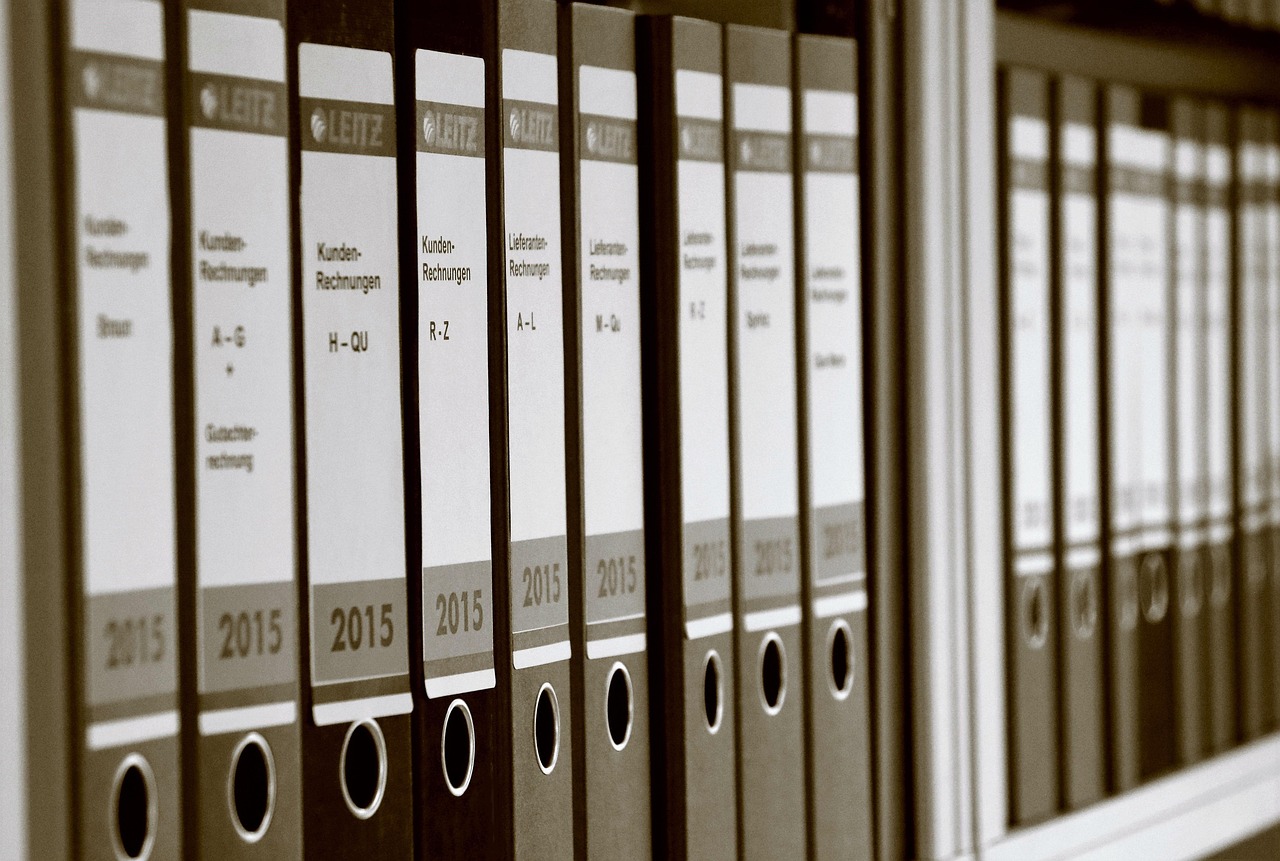
Live files are things you will touch this month: under the desk, immediate reach. Closed files are finished matters from this year: the lateral cabinet across the room. Archive is everything older: a box file, a stackable unit, or off-site.
The movement between tiers is what stops the system silting up, and it needs a scheduled moment rather than good intentions. Once a quarter, an hour, live to closed. Once a year, closed to archive.
Label from the front
Tabs should be readable without lifting the folder. In a vertical drawer that means tabs in a single consistent position rather than staggered — staggered tabs look organised in a photograph and are slower to scan in practice.
Write the category and the year. Not the month. Month-level labelling is a level of precision nobody ever needs and it doubles the number of folders.
Decide the retention rule once
The reason drawers overflow is that nobody has decided what gets thrown away. Tax and accounting records have statutory retention periods; look yours up once, write them on a card taped inside the cabinet door, and then follow it.
Everything without a statutory period gets a default: two years, then out. Having a default is more important than the default being correct.
Colour, used sparingly
One colour for one thing. Red for anything with a deadline, or blue for one client that generates a lot of paper. Colour-coding a whole system means learning a key, and nobody learns the key.
What to buy
A mobile pedestal or under-desk cabinet for live files, a lateral cabinet for closed ones, and a few box files for archive. That covers a small office completely. See Mobile Pedestals and Printer Stands and Desk Organisers and File Boxes.
All articles
Browse the full range in the shop, read the frequently asked questions, or contact us — Sandia Office Supply, Albuquerque, NM.